Details
The image
A pattern that repeats in two directions: leaves and flowers interlaced so densely that the eye cannot find a centre, colour held to two or three flat tones. The design has no top and no bottom, which is what allows it to continue past the edge of the sheet.
Where it comes from
William Morris argued that decoration should be made by hand and understood by everyone and he designed wallpapers, textiles and books on that principle. His patterns avoided perspective and shading on purpose: a repeating surface, he believed, should be read as a surface and not as a window. The argument shaped the Arts and Crafts movement and, through it, a century of printed pattern.
On the wall
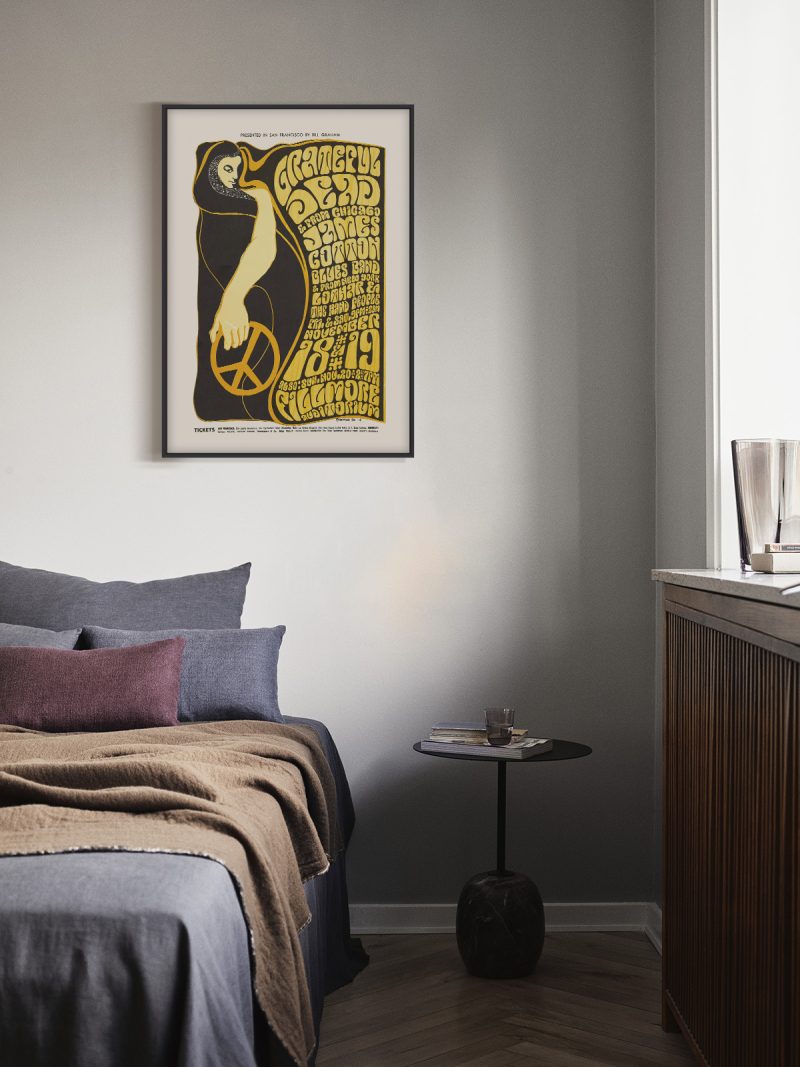
It works where a wall needs density rather than a subject: a reading corner, a hallway, a bedroom with plain furniture. Because the pattern has no centre, it suits narrow walls and awkward spaces. In a group it should be the piece that fills a gap without demanding attention.
In company
A second sheet from the William Morris collection will sit beside it without argument.Avoid hanging it next to a strong figurative image, the repetition would read as background instead of as the subject.