
Paul Klee
Paul Klee posters: thin lines, small signs and warm colour fields that reward a second and a third look. Browse the set and compare.
Showing all 5 resultsSorted by latest



Paul Klee posters: drawing that behaves like painting
Paul Klee (1879–1940) was a Swiss-born artist who taught at the Bauhaus alongside Kandinsky. He worked small and slowly, and his pictures sit between drawing and painting: thin lines, grids, letters, small figures and symbols laid over warm watercolour grounds. A trip to Tunisia in 1914 changed the way he used colour, and much of what he made afterwards carries that Mediterranean light.
What is in this collection
- Motif from Hammamet — Motif from Hammamet comes out of the Tunisian journey: a grid of colour fields, half architecture and half memory.
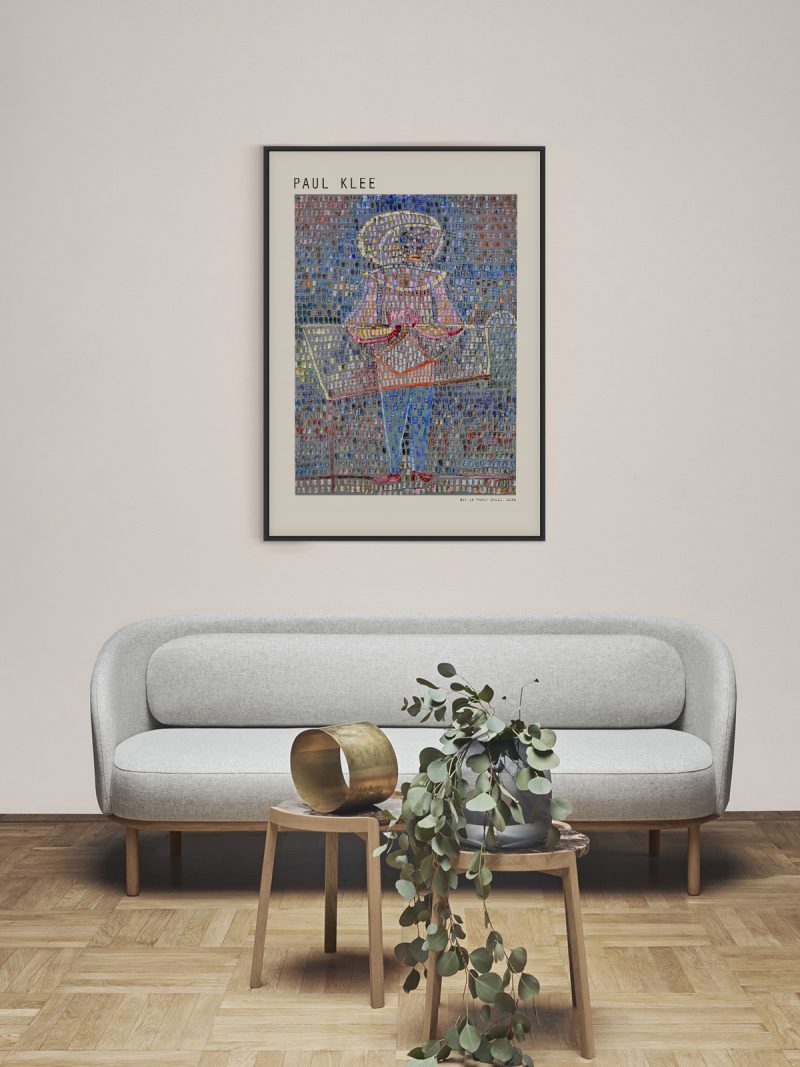
- Blossoming and figures — Blossoming and Boy in Fancy Dress show the other side of his work: plants and people reduced to a few lines, with a child's seriousness.
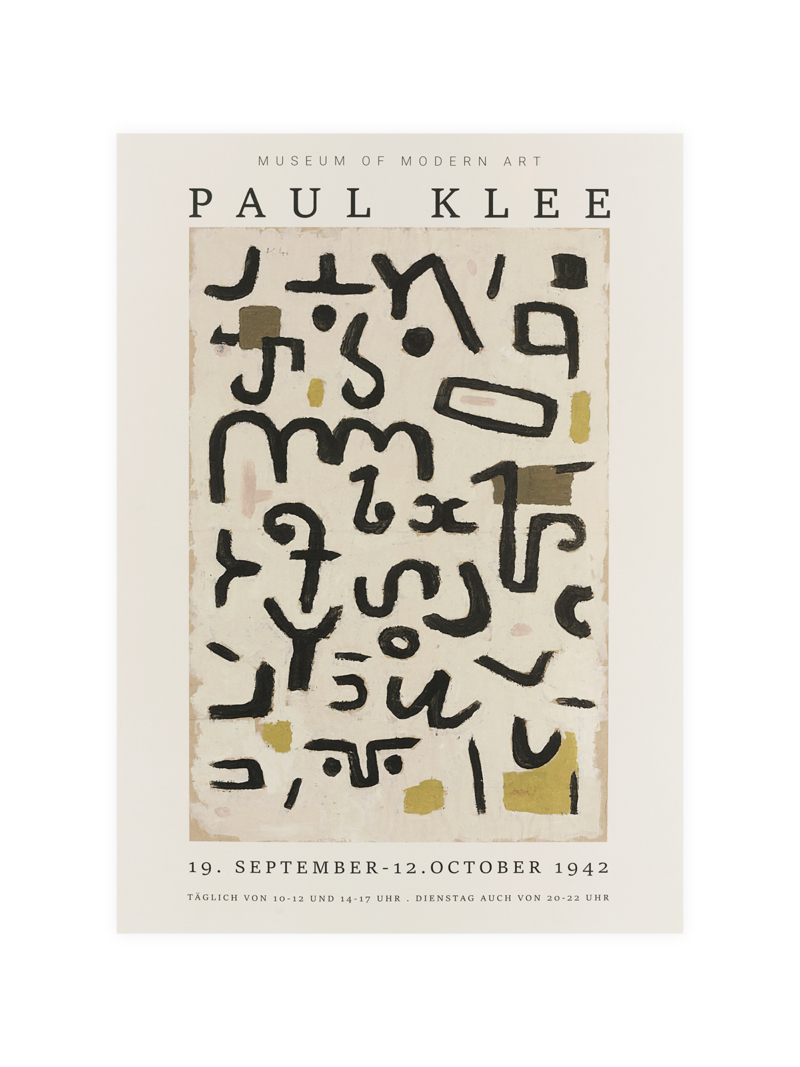
- Exhibition and joint prints — the 1942 MoMA exhibition poster, and Klee and Kandinsky, a print that puts the two Bauhaus colleagues side by side.
How to choose one
Klee works small. A single print at 30×40 or 40×50 hung low, at eye level above a desk or a sideboard, does more than a large format on an empty wall. If you want a bigger presence, hang three prints as a group rather than one large one — his compositions are dense and reward close looking.
Next to Kandinsky the difference is obvious at once: Kandinsky builds with colour and geometry, Klee with line and a private alphabet. A pair of the two is the most natural way to show both.
Sizes, paper and delivery
Every poster is printed on Hahnemühle paper and is available in sizes from 30×40 to 70×100 cm, plus A3 and A2. Orders leave the studio within 24 business hours, delivery in the EU takes 3–5 working days (3–6 outside the EU), and every parcel is tracked.
Why Klee rewards a second look
Nothing in a Klee picture is quite what it first appears to be: what looks like a face resolves into a letter, a roof into a triangle. That is why his prints stay interesting in a room you actually live in — you keep finding the parts again.
Browse the whole shop or see all artists.