Details
The image
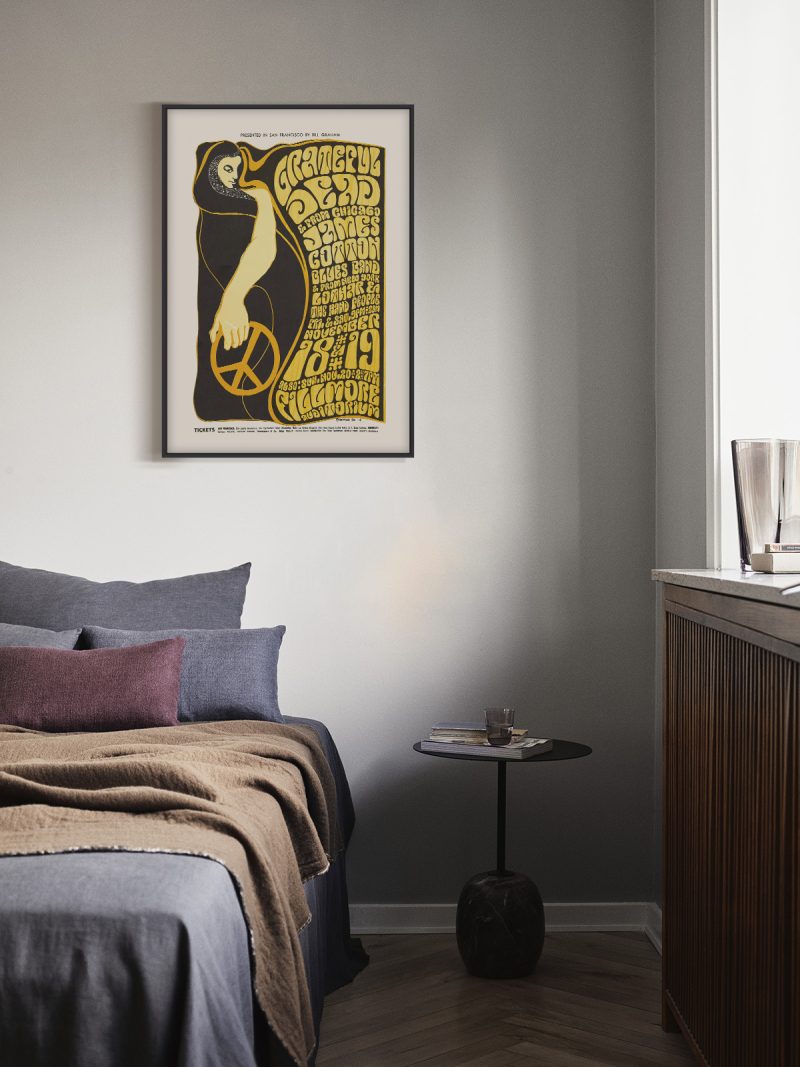
Figures drawn in one continuous outline, dancing across a saturated ground, their bodies simplified to the point where the movement is carried by the shape rather than by the detail. There is no background and no perspective, and the whole sheet is built from a single line repeated until it fills the space.
Where it comes from
The language of the dancing figure, drawn with an even outline and filled flat, came out of the New York subway drawings of the early 1980s and travelled immediately into posters, murals and record sleeves. Jazz festivals adopted it because the drawings behaved like the music: a line that keeps moving, no shading, and a rhythm that the eye follows without being told where to look. The economy of means was practical as well as aesthetic, since a poster printed cheaply needs a shape that survives at any size.
On the wall
It brings movement and colour into a room, so it suits a studio, a hallway, a teenager’s room or a kitchen with strong walls. Because the composition is open and the palette limited, it holds a large wall without weight. In a group it should be the piece that sets the tempo.
In company
Printing of this period is what the Music collection is made of.Avoid hanging it beside tight realistic drawing, where the outline would look unfinished rather than deliberate.