
Matisse Posters, From Cut-Outs to the Nice Posters
Three posters, one artist, and three completely different ways of putting colour on a wall. One is a cut-out shape floating on a pale ground. One is a line drawing above a block of French type. One is a travel poster with a black background and a red table.
They are usually sold as the same thing. They are not. Each asks for a different wall, a different size and a different amount of wall around it, and getting that wrong is what makes a Matisse look like a printout.

The cut-out, and why it needs space
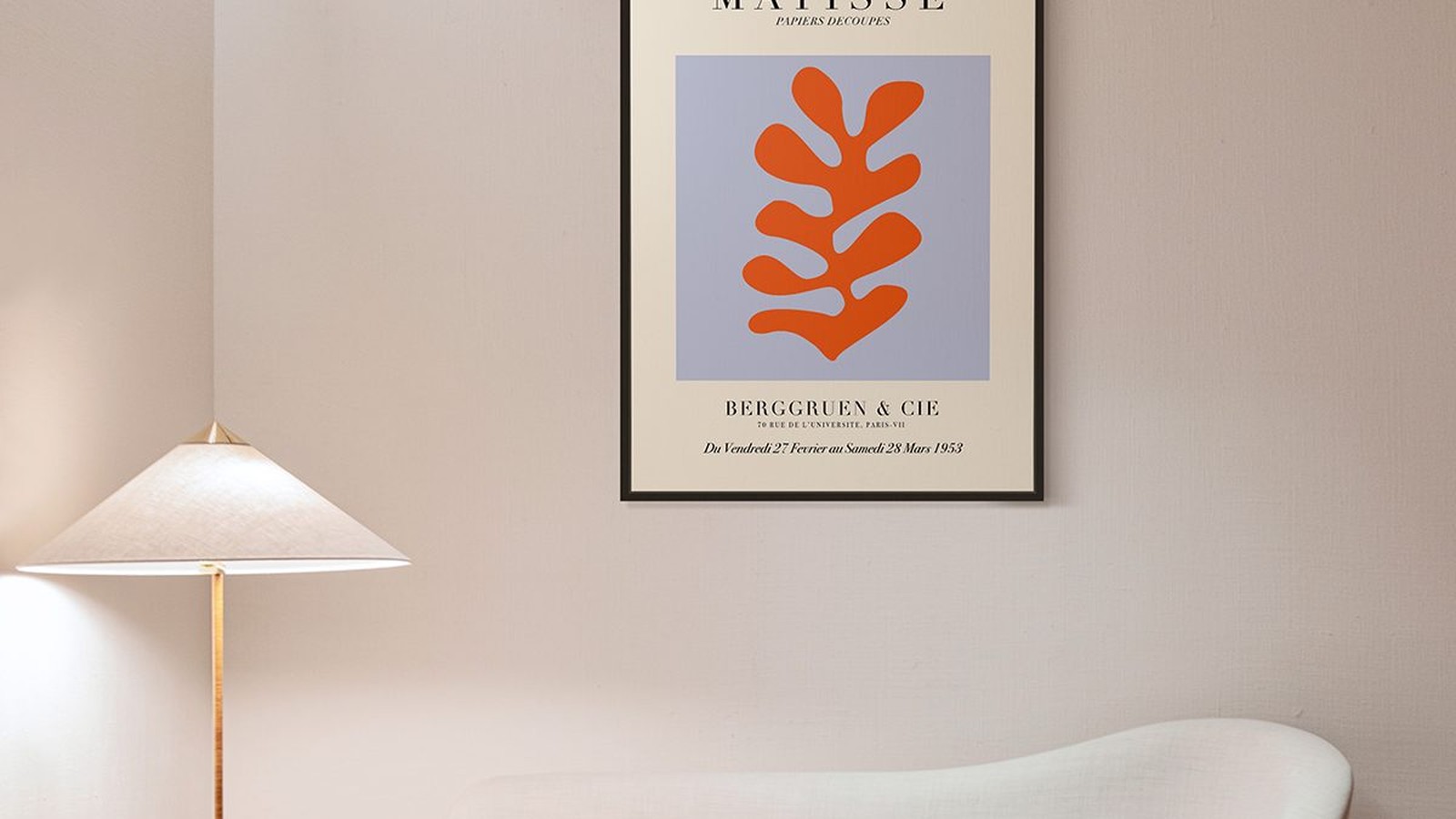
In his last years Matisse stopped painting and cut shapes straight out of paper painted with gouache, using scissors the way other artists use a pencil. The result is a form with a cut edge, no shading and no background: a single shape on a flat ground.
That is why this print needs emptiness around it. The shape is the whole image, so anything beside it competes. One wall, one print, and at least half a metre of bare wall on each side.
Colour in the cut-outs
The palettes are narrow on purpose: orange on pale lavender in ours, sometimes blue on cream, sometimes green on white. Two colours, no third. Match the wall to the ground of the print, not to the shape, and the room stays calm.

The exhibition poster is a document
The second type is a printed announcement. A line drawing sits in a yellow square at the top, and below it a block of type: the gallery, the address, the dates, the publisher. It was made to be read on a street, which is why the letters are so large in proportion to the drawing.
Hung at home, it carries that history with it. The type is part of the composition, so do not crop it in the frame and do not hang it where the bottom half is hidden behind furniture.
Where it belongs
These suit a hallway, a study, the wall above a desk. Somewhere you stand close enough to read the smallest line. In a large living room they can look like paperwork next to a bigger image.

The travel poster is the loudest of the three
Black ground, green fronds, a red table with lemons, and the word Nice written across the bottom in blue script. This is commercial work, made to sell a place, and it uses the strongest contrast of anything in the range.
It is also the easiest to hang, because it behaves like a picture rather than a shape. It can sit above a sofa, in a dining room, in a hallway. What it cannot do is share a wall with another strong colour.
Sizes, in plain terms
The cut-outs hold at 50 x 70 cm and look best at 70 x 100 cm, where the shape can breathe. The exhibition poster suits 50 x 70 cm, and below 40 x 50 cm the type becomes unreadable. The travel poster works at any size in the range, though at 30 x 40 cm the script starts to disappear.
Frames, and the one mistake people make
Thin black or natural wood, twenty to twenty five millimetres, no wide mount. Matisse’s compositions already contain their own empty space, and a mount adds a second frame inside the frame.
The mistake is a coloured frame chosen to match the artwork. An orange frame around an orange cut-out turns a print into decoration. Neutral frames let the colour do the work.
Keep the centre at 145 to 150 cm from the floor, bottom edge 20 to 30 cm above the furniture, and keep the objects below low. A tall lamp in front of a cut-out breaks the clean field the shape depends on.
Prints From the Matisse Collection


FAQs
Are these original Matisse prints?
No. We print reproductions on matte 210 gsm Hahnemühle paper, from 30 x 40 cm to 70 x 100 cm. We do not sell originals or limited editions.
Which Matisse poster is easiest to live with?
The travel poster. It behaves like a picture and tolerates a room with other things in it. The cut-outs need an empty wall.
What wall colour suits a cut-out?
White, off-white or the pale tone of the print’s own ground. Our guide to poster sizes lists every format, and there is more on the cut-outs in this piece on colour and plain walls.