
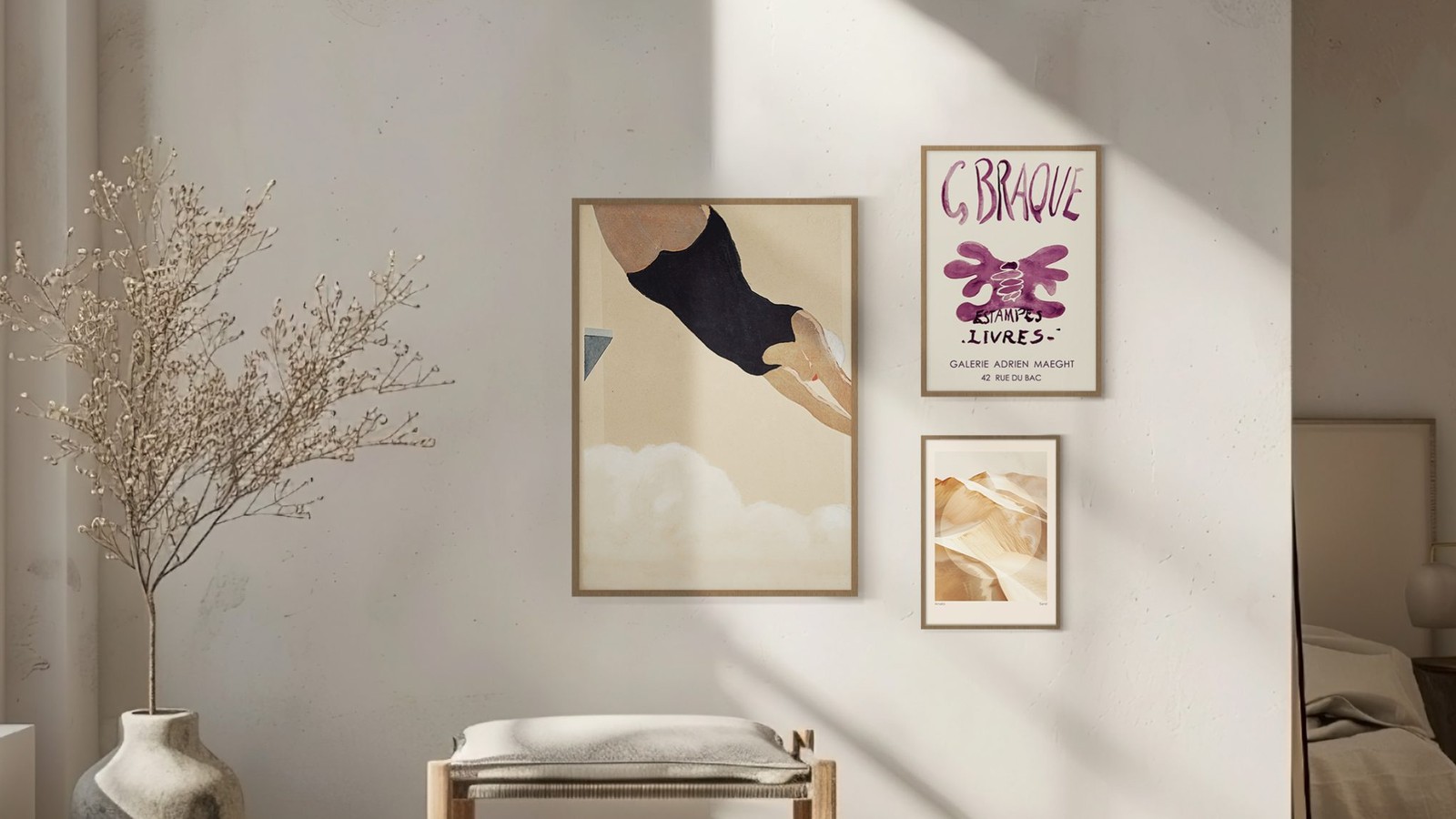
Gallery Wall Layouts That Actually Work
A gallery wall fails for one of two reasons. Either the frames are too far apart, or the whole group sits too high. Both are easy to fix before the first nail goes in, and both are almost impossible to fix afterwards.
Below are the three layouts that survive contact with a real wall, the spacing that holds them together, and the mistakes we see most often in photographs sent to us.
The three layouts worth knowing
Almost every good gallery wall is one of these three shapes. Pick the shape first, then the prints.
- Three in a row. Three prints of the same format, side by side, on one horizontal line. This is the calmest option and the easiest to get right. It suits a sofa, a sideboard and a hallway.
- Five in a grid. Two rows, three prints on the top row and two on the bottom, or the other way round. The group reads as one block because the outer edges line up.
- Seven as a block. One large print in the middle, six smaller ones around it. This one needs a large wall and patience, because every gap has to stay equal.
If you are unsure, choose three in a row. A small group that is perfectly aligned looks more considered than a large group with one frame slightly out of line.
Spacing, in numbers
Between frames, leave 5 to 8 cm. That is a hand’s width, and it is the gap the eye reads as deliberate. Under 5 cm the frames crowd each other, and above 8 cm the group stops looking like a group.
Keep the gap identical everywhere in the group, including vertically. The single most common problem in a gallery wall is a horizontal gap of 6 cm and a vertical gap of 12 cm, which makes the whole arrangement look like it is unravelling.
Height, using the same rule as a single print
The centre of the whole group sits between 145 and 150 cm from the floor, exactly like a single poster. Not the centre of each frame, the centre of the block.
Above a sofa, leave 20 to 30 cm between the back of the sofa and the bottom edge of the lowest frame. If the group then reaches above 150 cm at its centre, the group is too tall for that wall and should lose a row.
Mixed sizes without a mess
Prints of different sizes work when they share one line. Choose the line before you hang anything.
- Shared centre line. Every frame is centred on the same horizontal axis, and different heights stick out above and below. Calm, works with three or five prints.
- Shared bottom line. Every frame rests on the same horizontal axis, like books standing on a shelf. Works well above a sideboard or a desk.
- Shared top line. The opposite of the bottom line. Use it when the group hangs high, for example above a door, and you want one clean edge at the top.
Do not mix two of these rules in one group. If the bottom edges line up on three frames and the centres line up on two others, the wall reads as unfinished.
Plan it on the floor first
Lay the frames on the floor in the shape you want and photograph them from above. Move them until the gaps look right, then measure the gaps you ended up with and copy those numbers onto the wall. This takes ten minutes and saves the wall.
For the wall itself, cut paper templates to the size of each frame and tape them up. Paper tape leaves no mark, and you can stand back two metres and decide before committing to a nail. When the paper looks right, mark the hook positions through the paper.
Four mistakes we see over and over
- The group is too high. Somebody measures from the furniture to the top frame instead of the floor to the centre. Push the whole group down 10 cm and it usually fixes itself.
- The gaps are too large. Twelve centimetres between frames turns one arrangement into four lonely prints. Bring them to 6 cm.
- The frames are all different. Four frame colours and three depths compete with the prints. One frame style for the whole group, always.
- The group is not centred on the furniture. Centring it on the wall instead of the sofa is visible immediately, even if nobody can say why.
If you are still choosing the prints, our guide to poster sizes lists every format in centimetres and inches, which is what you need to plan the gaps before ordering. The shop shows each print in every format we make.
FAQs
How far apart should pictures be on a gallery wall?
5 to 8 cm between frames, the same distance horizontally and vertically. A hand’s width is the simplest way to check it.
How high should a gallery wall hang?
Centre the whole group, not the individual frames, between 145 and 150 cm from the floor.
Can I mix frame sizes in one gallery wall?
Yes, as long as all frames share one line, either centre, top or bottom. Mixing the alignment rules is what makes a mixed group look untidy.
How many prints should a gallery wall have?
Start with three. A group of three that is level looks better than seven that are not, and you can always add a second row later.
Prints That Work Well in a Group


