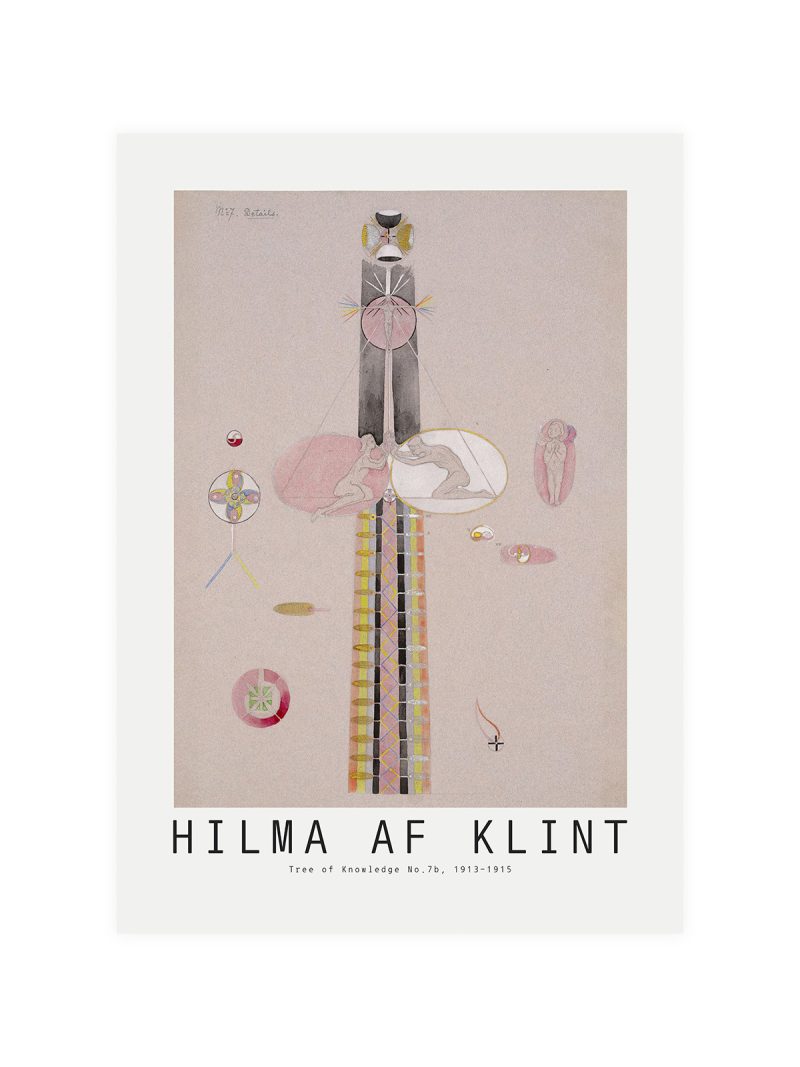
Details
The image
Small patches of colour distributed across a pale ground, each enclosed by a drawn boundary, some touching and some held apart, with circles meeting squares where the composition tightens. The arrangement looks like a study rather than a finished picture, the eye is invited to compare one patch with the next rather than to look at a scene.
Where it comes from
The sheet reproduces a colour study by Wassily Kandinsky, of the kind he made while teaching at the Bauhaus in the 1920s, where hue was treated as a material to be tested: how two colours behave side by side, which pairs advance and which recede, what a small area does to a large one. Those exercises were teaching material but they became some of the most reproduced images of the period, because they show the argument rather than its result.
On the wall
It suits a study, a hallway or a modern living room, where a grid of colour gives a wall rhythm without a subject. Because the patches are small and the ground is wide, it rewards being seen close up as well as from a distance. In a group it should be the piece that introduces colour.
In company
If the wall is to hold another sheet, the rest of the Kandinsky collection follows the same rules.Avoid hanging it beside large flat fields of colour, the small patches would stop reading as a comparison.