
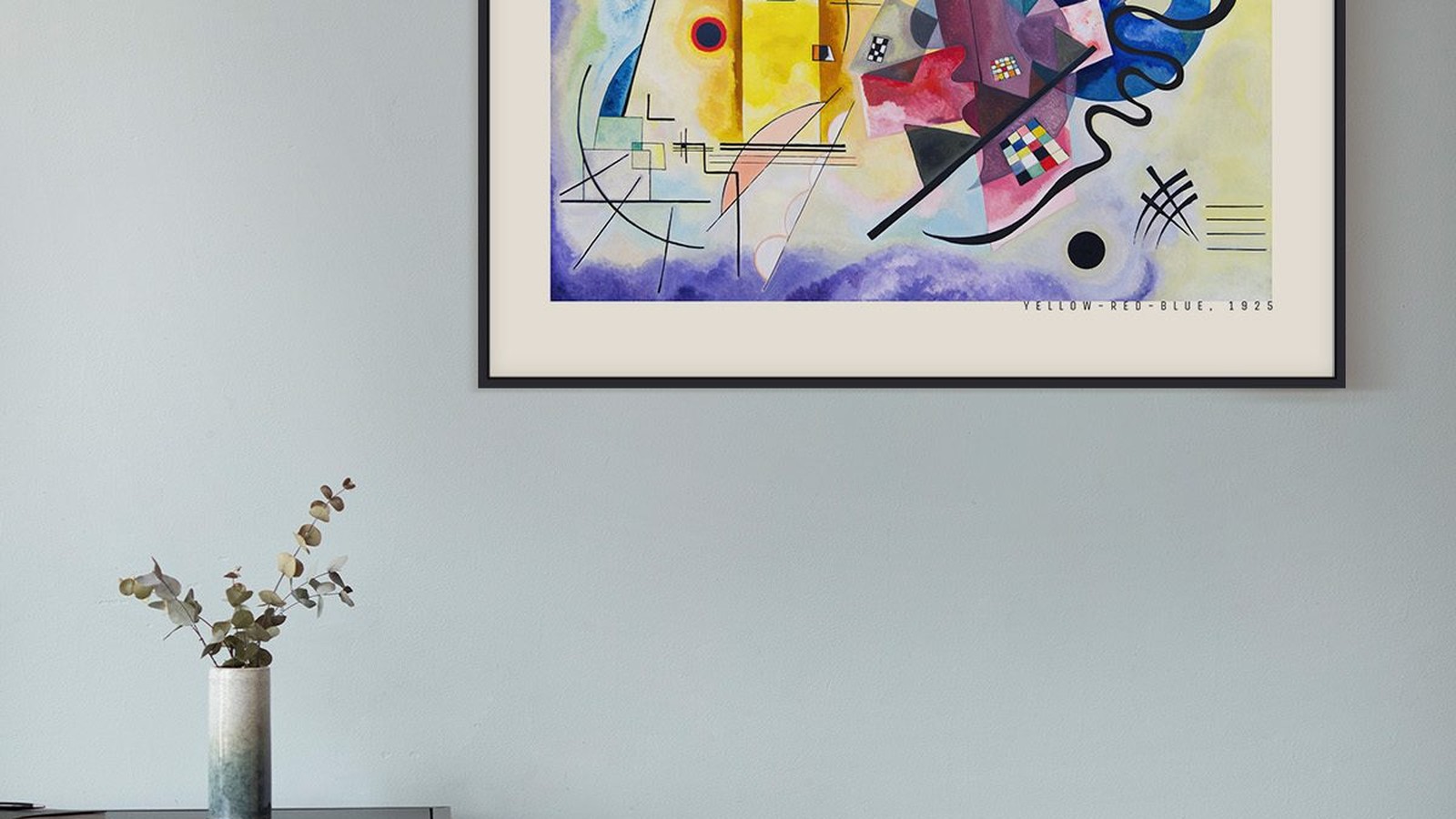
Fusing Art Wall and Interior Style
An art wall is not a collection of things you liked one at a time. It is one composition made of several prints, and it either looks deliberate or it looks like the wall of someone who kept buying. The difference is arithmetic, not taste.
Below is how we build one: how many prints, which sizes, how far apart, and the two rules that decide whether the wall holds together.

Start with the wall, not the prints
Measure the wall and the furniture under it. Take the width between the sofa or sideboard edges, not the room, and use 60 to 70 percent of it. A group that covers the whole wall reads as wallpaper; a group that covers half of it reads as a decision.
Then decide the centre line: 145 to 150 cm from the floor. Every print in the group is placed relative to that line, not relative to the ceiling.
Two rules that hold a group together
Same frame, same spacing. Black, thin, identical width, and 5 to 8 cm between every print both ways. Those two decisions do more for a mixed wall than any choice of images.

How many prints
Three is the number that almost always works: one large and two small, or three of the same size in a row. Five works on a wide wall if the frames and formats match. Seven needs planning on the floor with paper templates before anything goes up.
Odd numbers work better than even ones because they give the eye a centre. An even group asks the viewer to find its middle, and there is nothing there.
Choose one loud print
In any group, one print should be the reason the wall exists. The others support it: quieter colour, smaller scale, less contrast. Two loud prints in one group cancel each other, and you end up with a wall that is busy without being interesting.
Pattern belongs here once. A repeating motif adds texture beside two graphic prints, and ruins the group if it appears twice.

The layout that survives real rooms
Align the bottom edges of the group, not the tops. Bottom alignment keeps the wall tied to the furniture, and it tolerates one print being taller than the rest. Top alignment only works with identical sizes.
For a group of three, put the largest in the middle and the two smaller ones at the same height on either side. For five, build a row of three and hang the remaining two centred above or below, never in the corners.
Before you drill
Cut paper templates to the exact size of each print, tape them to the wall, and live with the arrangement for a day. Almost every mistake on an art wall is visible at that stage and invisible after the first hole.
Then hang from the middle outwards, checking level after each print. One print hung two millimetres off tilts the whole group.
Colour, in a group rather than a single print
Pick the palette from the loud print and let one colour repeat in the others. A red accent in one image and a red detail in another is enough; you do not need the same red. What breaks a group is a colour that appears once and nowhere else, because the eye keeps returning to it.
Walls stay neutral: white, off-white, pale grey. If the wall is strong, the group needs to be curated around it, and that is a different job.
Prints From the Collections





FAQs
How many prints should an art wall have?
Three to five for most rooms. Seven or more needs a wall of its own and templates on the wall before drilling.
Do the frames have to match?
Yes, if the images differ in style. Identical frames are what make a mixed group read as one composition.
What sizes work together?
Two or three formats at most, for example one 70 x 100 cm with two 50 x 70 cm prints. Our guide to poster sizes lists every format we print with the wall space it needs.