
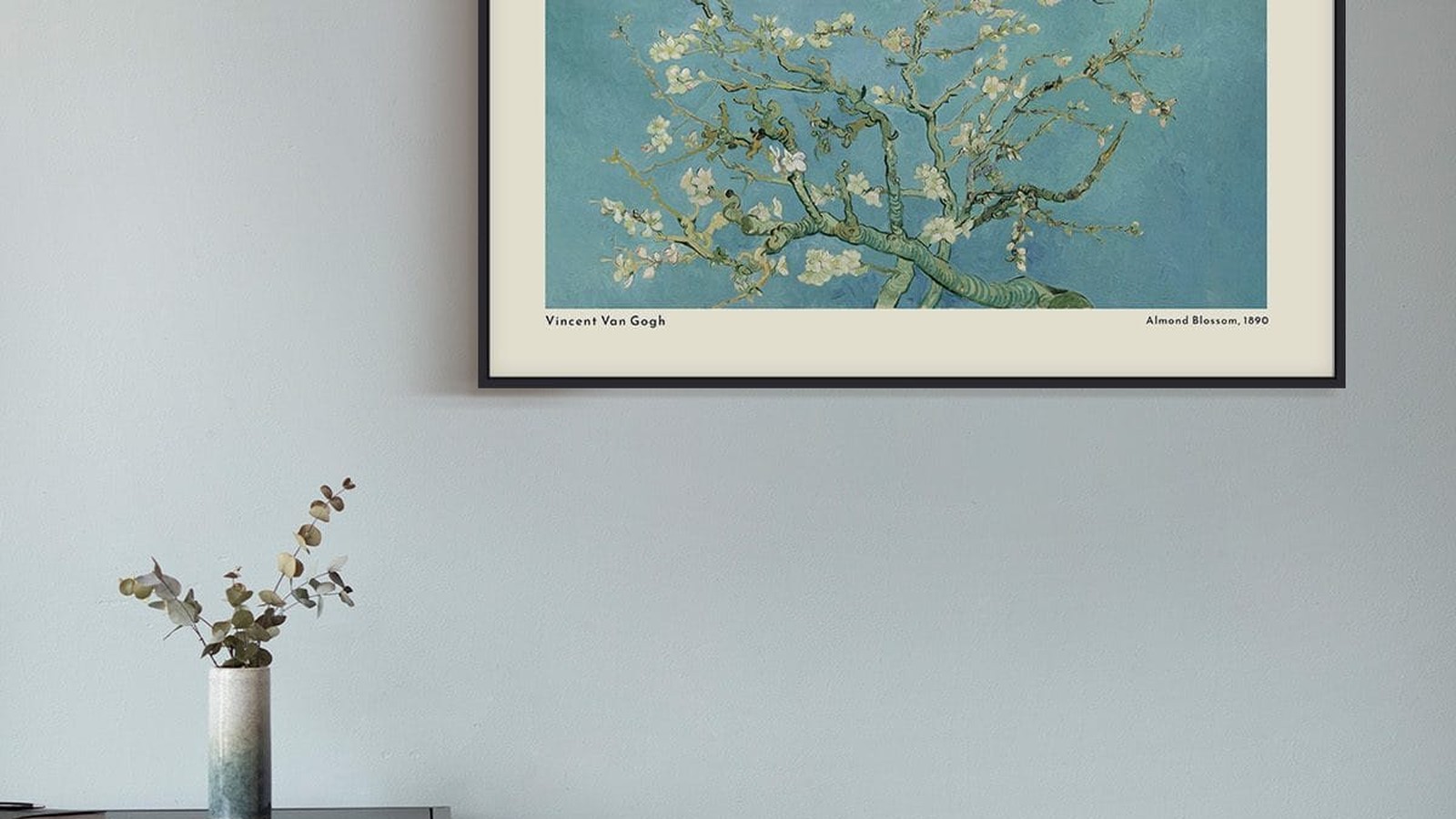
Van Gogh Posters for a Bright Wall
Van Gogh is the artist people ask for when they want colour that does something. The yellows in a sunflower print and the blues in an almond blossom print are strong enough to change the mood of a room, and that is exactly why they are easy to get wrong.
Here is what to think about before you hang one.
These prints need light, and they need the right light
A saturated yellow goes flat in a dark corner. If the wall gets no daylight and no lamp, the print will look like a faded copy of itself.
Put Van Gogh prints where the room already has light: opposite a window, beside a lamp you use in the evening, or on a wall that stays pale. Avoid the wall that only gets a hard, direct sun for two hours a day, because that is the wall that fades a print fastest.
Walls that let the colour speak
White, off-white and pale grey work with every Van Gogh print we make. Warm walls are trickier. A yellow print on a beige wall loses its edge because the two colours sit too close together, while the same print on a cool grey jumps forward.
If you want a coloured wall, go the other way. A deep blue wall behind an almond blossom print makes the branches read like a drawing, and it is the one combination we see that reliably looks better in a room than it sounds on paper.

Sunflowers, blossoms and what each one does to a room
- Sunflowers. Warm, dense, cheerful. Best in a kitchen, a dining room or a hallway where you pass it every day. It is a print that lifts a space rather than calming it.
- Almond blossom. Cool blue with white flowers. Quieter, and it suits bedrooms and reading corners, especially in spring and summer when the rest of the room is light.
- Landscapes and skies. Graphic and horizontal. They work above a sideboard or a low sofa, and they suit rooms with a lot of horizontal lines.

Frames that keep the yellows alive
A natural oak frame sits close to the warm side of a sunflower print and makes the whole thing look softer. A thin black frame does the opposite: it separates the print from the wall and makes the colours read stronger.
Do not use a coloured frame. Yellow next to yellow, or blue next to blue, flattens the print and makes it look like a poster cut from a magazine.
Sizes and placement
50 x 70 cm is the safe size above a sofa or a sideboard. 70 x 100 cm works when the print is the only thing on the wall. Hang the centre between 145 and 150 cm from the floor, and leave 20 to 30 cm between the bottom of the print and the furniture.
Two Van Goghs side by side work better than three, because the colours are strong and three of them start to compete.

What you are buying
Our Van Gogh posters are printed reproductions on matte paper, not originals and not limited editions. Colour is matched to a scanned reference, and screens vary, especially with strong yellows. The printed sheet is the reference.
See the rest in the Van Gogh collection.
What the print looks like in winter
Yellows are the first thing to go when the light drops. A sunflower print that looks warm in June looks duller in December, in the same room, on the same wall. This is not a fault of the print, it is how our eyes read colour in low light.
The practical answer is a lamp. A warm bulb at 2700 to 3000 K placed to the side of the print brings the yellows back in the evening without washing out the blues. Avoid a bulb directly in front of the glass, because the reflection will be the only thing you see.
Two prints, not three
Because the colours are strong, two Van Gogh prints side by side is the arrangement that holds. Three of them compete, and the middle one loses. If you want a larger group, pair a Van Gogh with a quieter print of the same size, such as a Klee or a muted landscape, and let the Van Gogh be the loud one.
Hang the pair with 5 to 8 cm between frames, both frames the same size, and keep the whole pair centred on the furniture below.
Prints From the Van Gogh Collection

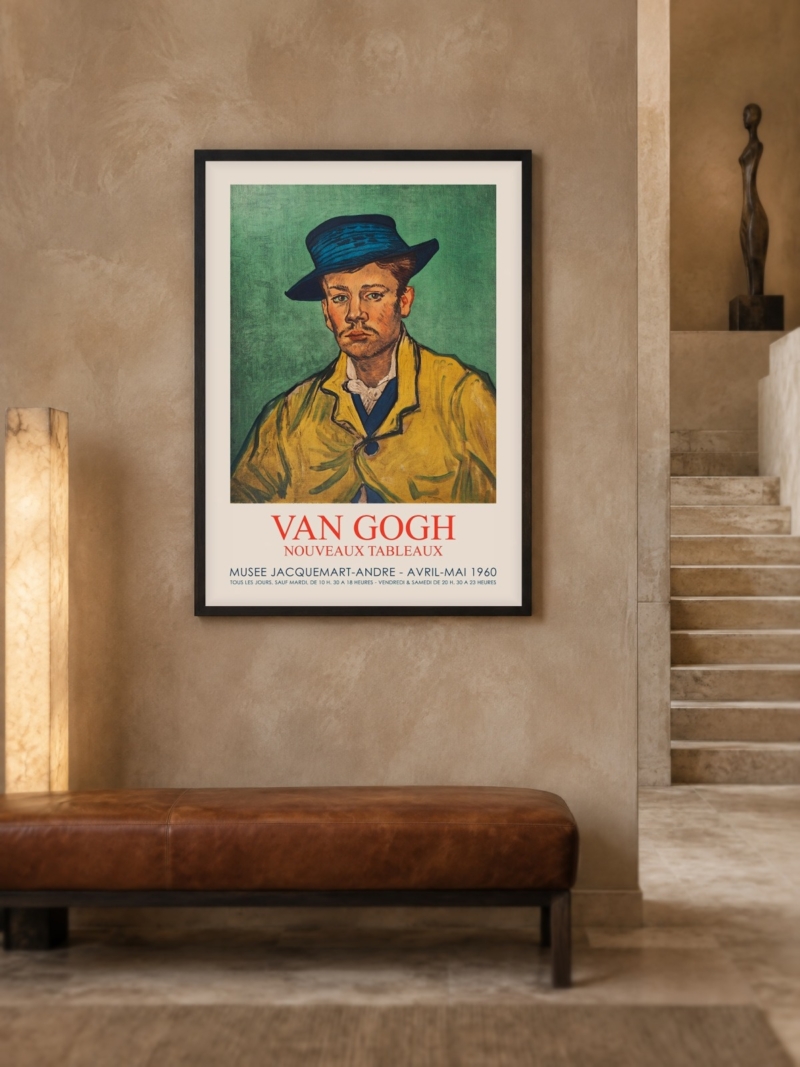


FAQs
Is the poster a reproduction?
Yes. We print reproductions on matte paper, in the formats listed on each product page. We do not sell originals.
What size works best?
Above a sofa or a sideboard, 50 x 70 cm. On a wall of its own, 70 x 100 cm. Our guide to poster sizes lists every format with the space each one needs.