
Taguchi Tomoki Woodblock Prints and How They Sit on a Wall
Three different kinds of image, one printing method. In our Taguchi Tomoki series there is a crane with painted feathers, a pair of round motifs drawn in black line, and two fields of worked colour with birds reduced to a mark. What connects them is woodblock: colour laid down flat, one carved block per tone, no shading anywhere.
That is what makes them easy to live with and hard to hang badly. Below is how each type works on a wall, and the sizes that hold.

A bird is the easiest place to start
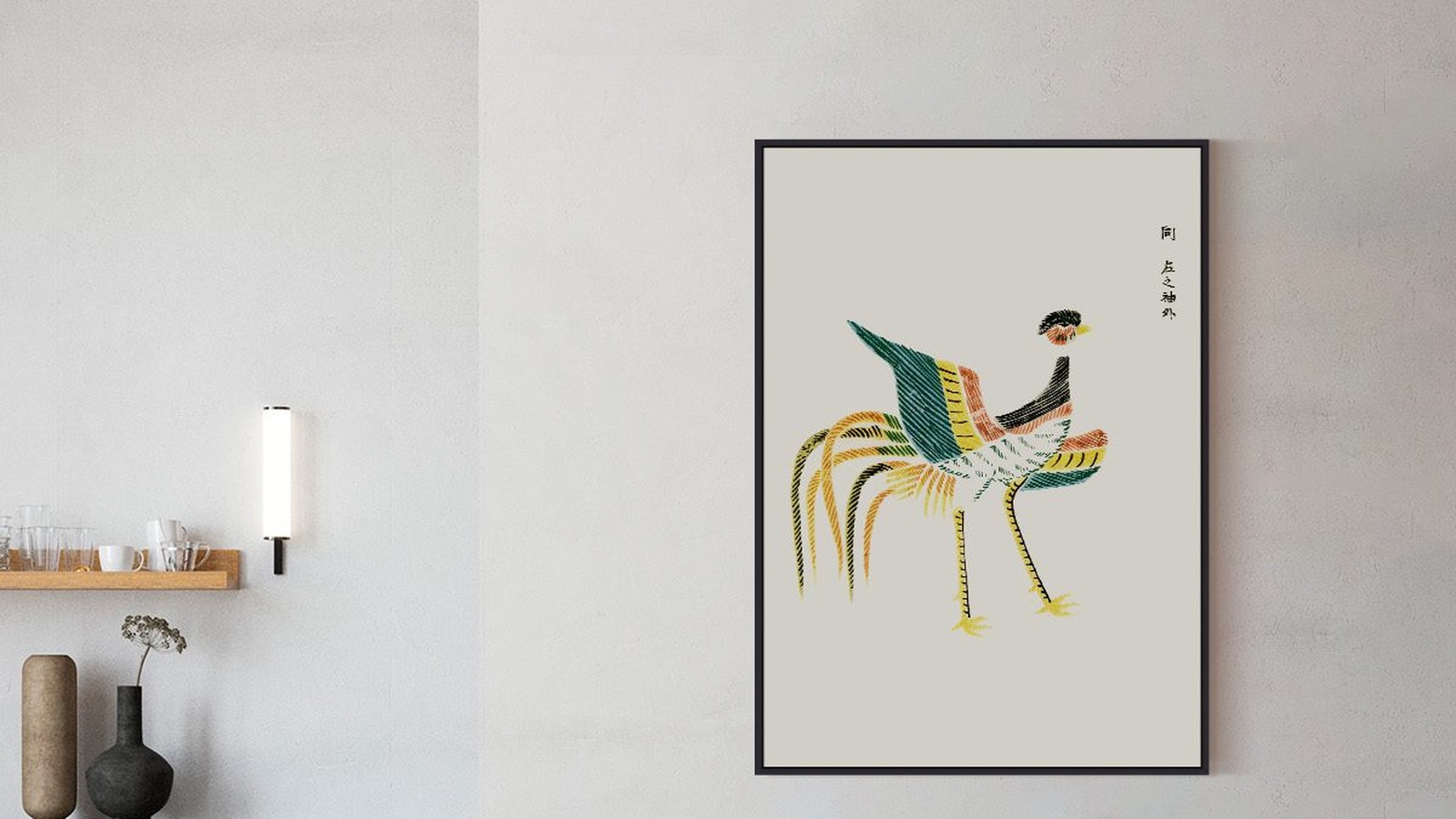
The crane sits in the middle of the sheet on a warm cream ground, its feathers set in green, red and yellow, a column of calligraphy down the right edge. Nothing behind it, no landscape, no shadow.
A subject like this gives a room a centre. Hang one above a table or beside a door and the eye lands on the bird before it reads the wall.
Why the margins matter
Woodblock prints were designed with the sheet in mind, not just the drawing. The empty space at the sides is part of the composition, which is why a crowded wall undoes them.
Frame with a thin profile and no wide mount, and leave at least half a metre of bare wall on either side.

Line and pattern, with no shading at all
The second type is pure line: two circular motifs, one fine and one closer to a tree, stacked on a pale sheet with calligraphy beside each. It reads as a diagram or a botanical study, and it holds attention because there is nothing to decode.
On a wall it behaves like a drawing rather than a poster. Put it where you can stand close: a hallway, a kitchen, the narrow wall beside a bookshelf.
What this means at different sizes
Line work needs less width than a colour field. At 30 x 40 cm it is an intimate object. At 50 x 70 cm it becomes a proper poster and the line still holds. Above that the strokes start to look thin for the format.

Birds on a worked field
The third type keeps the birds but takes away the scene. In the blue print on this page a handful of white birds fly over a field worked into wave texture, with calligraphy at the top right. The field is sky and water at the same time, and the birds are what tells you so.
From across the room it reads as one colour. Up close it is a flock and a surface.
This is the most forgiving of the three and the one that fills a large wall without shouting. It also works well in a pair, two fields of different colour, same frame, 5 to 8 cm apart.
Wall colour and light
All three want a quiet wall: white, off-white, chalk, pale grey. The palettes are narrow, so a strong wall colour changes what the print looks like rather than supporting it.
Keep them out of direct afternoon sun. Flat ink on matte paper fades unevenly and the first thing to go is the red.
Hanging more than one from the same series
Identical frames, identical format, 5 to 8 cm between them, and a vertical stack rather than a row. Japanese print series were made to be looked at one at a time, and a stack keeps that rhythm.
Centre the group between 145 and 150 cm from the floor, leave 20 to 30 cm above the furniture, and keep the bottom edges aligned. If you own only one, give it the wall it needs: a 50 x 70 cm print with a metre of empty wall either side looks deliberate, the same print surrounded by other frames looks stored.
Prints From the Taguchi Tomoki Collection


FAQs
Are these original woodblock prints?
No. We print reproductions on matte 210 gsm Hahnemühle paper, in sizes from 30 x 40 cm to 70 x 100 cm. We do not sell originals or hand-pulled editions.
Which of the three types suits a small room?
The line work. It carries detail at 30 x 40 cm, where a colour field would look like a swatch.
What size should I choose?
50 x 70 cm for a wall with furniture under it, 70 x 100 cm for the colour fields only. Our guide to poster sizes lists every format, and the Japanese range is in the Japanese collection.